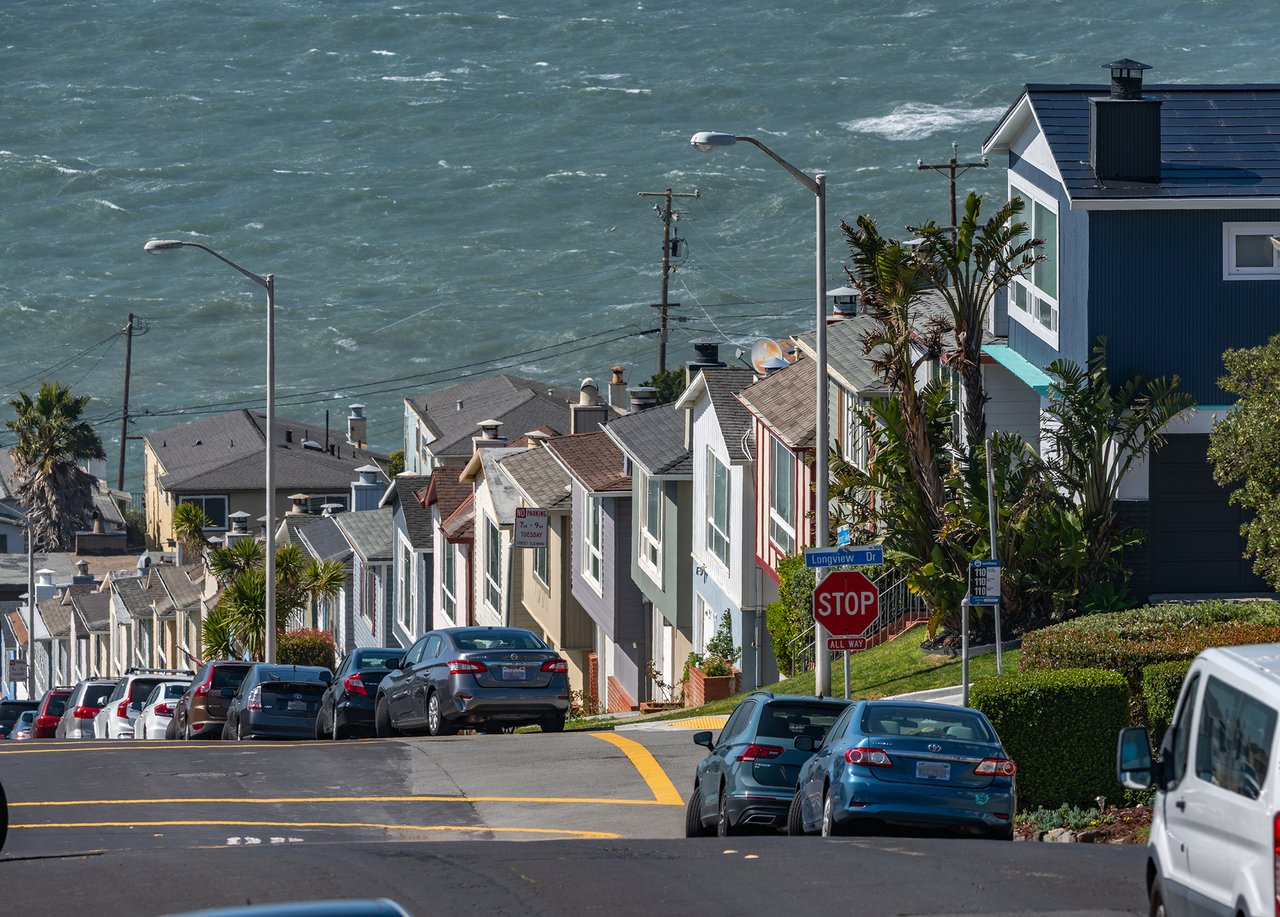
Buying a Home in Pacifica vs. Daly City vs. San Francisco: Which Is Right for You?
Buyer-Focused Brooke Lau September 15, 2026
Buyer-Focused Brooke Lau September 15, 2026
If you are thinking about buying a home on the San Francisco Peninsula, three places often end up on the same shortlist: Pacifica, Daly City, and San Francisco.
They are close geographically, but living in each one can feel very different.
Pacifica offers coastal living, beaches, open space, and a more suburban pace. Daly City provides proximity to San Francisco, access to BART, established residential neighborhoods, and a wide variety of homes. San Francisco offers the most urban lifestyle, extensive public transportation, restaurants, cultural attractions, and some of the most diverse neighborhoods in the Bay Area.
There is no single right choice. The better fit depends on your budget, commute, desired lifestyle, property type, parking needs, tolerance for fog and wind, and how important walkability or direct ocean access is to you.
As of August 2026, the median sale price was approximately $1.31 million in Pacifica, $1.19 million in Daly City, and $1.59 million in San Francisco based on Redfin's three-month data. These are citywide figures across all home types, so individual neighborhoods and property types can vary significantly. (Redfin)
Pacifica | Daly City | San Francisco | |
|---|---|---|---|
Typical price | Around $1.31M citywide median | Around $1.19M citywide median | Around $1.59M citywide median |
Commute | Convenient to SF by car, with transit options | Excellent access to SF and BART | Best for buyers working and living within the city |
Weather | Coastal, with significant neighborhood microclimates | Generally cool, foggy, and breezy | Varies considerably by neighborhood |
Ocean access | Direct beach and coastal access | Close to the coast, but generally not a beach-town lifestyle | Ocean access in western neighborhoods |
Neighborhood feel | Coastal and suburban | Residential and suburban | Urban and highly neighborhood-specific |
Schools | Pacifica School District and other local options | Jefferson-area school districts and other options depending on address | SFUSD and private school options |
Property types | Primarily single-family homes, plus condos and other options | Single-family homes, condos, townhomes, multifamily | Condos, TICs, flats, single-family homes, multifamily |
Parking | Generally easier than SF, though it varies | Often more available than SF | Highly neighborhood and property dependent |
Walkability | Varies significantly by neighborhood | Varies by neighborhood | Generally the strongest of the three |
Lifestyle fit | Buyers who want coast, nature, space, and a quieter pace | Buyers prioritizing access, value, and proximity to SF | Buyers prioritizing urban living, transit, culture, and neighborhood variety |
Pacifica is one of the most distinctive communities on the Peninsula because of its combination of residential neighborhoods and direct Pacific Ocean access.
The city stretches along Highway 1 and includes more than six miles of beaches, coastal hills, parks, trails, and open space. The City of Pacifica describes the community as a collection of several distinct former beach communities rather than one traditional downtown-centered city. (City of Pacifica)
That matters when you are buying here.
Two Pacifica homes can have very different experiences depending on whether they are near the beach, higher in the hills, closer to Highway 1, or farther inland.
Pacifica can be a particularly interesting option for buyers who want:
Pacifica also has its own microclimates. A sunny afternoon in Linda Mar can feel very different from a foggy, windy morning in another part of town.
Linda Mar is one of the most recognizable Pacifica neighborhoods and is centered around Pacifica State Beach and the Linda Mar Valley.
The neighborhood has a more traditional suburban feel, with many mid-century homes, parks, shopping, restaurants, and easy access to the beach. The City of Pacifica identifies Linda Mar as its largest neighborhood and highlights its beach, parks, community facilities, and residential character. (City of Pacifica)
For buyers, Linda Mar can be appealing if you want beach access without giving up everyday convenience.
It is also worth paying attention to exactly where a home sits within Linda Mar. Homes closer to the beach can have a very different feel from properties farther up the hills.
Fairmont is in northern Pacifica and sits closer to Daly City and San Francisco.
The neighborhood has more of a traditional residential feel, with many established homes and elevated locations that can provide impressive views.
Because of its northern location, Fairmont can make sense for buyers who want Pacifica but have a commute toward San Francisco or Daly City.
The tradeoff is that northern Pacifica can experience more fog and wind than some of the sunnier southern areas.
Sharp Park has a different personality.
It is one of Pacifica's older neighborhoods and includes a mix of homes, the Pacifica Pier, beach access, a promenade, golf, and the Palmetto Avenue commercial area. The City of Pacifica notes that the neighborhood includes everything from converted summer cottages to modern custom homes. (City of Pacifica)
Sharp Park can be particularly interesting if you want coastal access plus more neighborhood amenities nearby.
West Sharp Park and East Sharp Park can also feel quite different, so I always recommend buyers explore the area on foot and at different times of day.
Pacifica is much more than Linda Mar, Fairmont, and Sharp Park.
Rockaway Beach has a more active coastal atmosphere, with restaurants, shops, the beach, and nearby trails.
Vallemar has a quieter, more wooded character and a tucked-away feel.
Pedro Point is known for dramatic coastal views and hillside homes.
Fairway Park offers a more established residential setting near the golf course and open space.
Park Pacifica has a more inland, residential feel with access to surrounding hills and trails.
This is one reason I encourage buyers not to search for Pacifica as if it were one neighborhood. The specific part of Pacifica you choose can have a major effect on your daily life.
Daly City sits directly south of San Francisco, making location one of its biggest advantages.
For many buyers, Daly City is the middle ground between San Francisco and the Peninsula.
You can have access to San Francisco while still finding established residential neighborhoods, single-family homes, condos, and properties with parking.
Daly City also has direct access to BART. The Daly City BART station is served by both SamTrans and San Francisco Muni, making public transportation an important part of the area's appeal. (Bay Area Rapid Transit)
The citywide median sale price was approximately $1.19 million over the three months ending August 2026, according to Redfin. (Redfin)
Westlake is one of Daly City's most recognizable residential communities.
It has a planned suburban feel, established homes, shopping, parks, and convenient access to San Francisco.
For buyers who want something that feels more residential than San Francisco but still want to remain close to the city, Westlake is worth exploring.
Oceanview, along with nearby southern Daly City neighborhoods, can offer a mix of single-family homes and condos with convenient access toward San Francisco and the Peninsula.
Because Daly City's neighborhoods can differ significantly in elevation, housing stock, transportation access, and street layout, buyers should evaluate the specific location rather than relying only on the city name.
St. Francis Heights and Serramonte offer established residential neighborhoods with convenient access to major roads and shopping.
Crocker has a more traditional residential character and is close to San Francisco.
Bayshore provides another option for buyers who prioritize proximity to San Francisco.
Daly City can make sense for buyers who want to be close to San Francisco without necessarily paying San Francisco prices or taking on a fully urban lifestyle.
San Francisco is a completely different experience.
Instead of choosing between a handful of suburban neighborhoods, you are choosing among dozens of communities with distinct personalities, housing styles, transportation options, and price points.
The citywide median sale price was approximately $1.59 million over the three months ending August 2026. But that number hides enormous differences between neighborhoods and property types. (Redfin)
For example, a buyer searching in San Francisco may encounter:
San Francisco can also offer significantly greater walkability and public transportation access than Pacifica or Daly City.
But buyers often have to make tradeoffs involving parking, outdoor space, square footage, stairs, HOA dues, building condition, and property type.
A buyer who loves the Castro may have very different priorities from someone searching in the Outer Sunset.
Someone who wants restaurants and nightlife might gravitate toward Hayes Valley, the Mission, the Castro, or the Marina.
Someone prioritizing quiet streets and parks may consider neighborhoods such as Cole Valley, Noe Valley, Glen Park, or the Sunset.
Someone looking for more space or a single-family home may look toward Bernal Heights, the Outer Sunset, the Outer Richmond, Excelsior, or other parts of the city.
San Francisco gives buyers the greatest number of lifestyle choices, but it also requires the most neighborhood-specific research.
Your commute should be one of the first things you consider.
If you work in downtown San Francisco, Daly City has a major advantage because of BART access. The Daly City station connects directly into the regional BART system and is also served by SamTrans and Muni. (Bay Area Rapid Transit)
Pacifica can work well for San Francisco commuters too, particularly depending on where you live and whether you drive or use connecting transit.
The Linda Mar area has a major transit hub, and Pacifica's location along Highway 1 provides direct road access toward San Francisco.
If you work primarily in San Francisco, however, living in San Francisco can eliminate the cross-city commute entirely.
For Peninsula commuters, the equation changes again.
Before choosing a city, I recommend doing the actual commute from the neighborhood you are considering during your normal work hours. A map distance does not always tell the full story.
Weather is an underrated factor when comparing these three locations.
Pacifica is famous for its coastal microclimates. One neighborhood can be sunny while another is foggy and windy.
Linda Mar is often associated with somewhat sunnier conditions, while higher-elevation northern areas can have more exposure to wind and fog.
Daly City is also known for cool, foggy coastal conditions.
San Francisco varies dramatically by neighborhood. The Sunset and Richmond can feel much cooler and foggier than neighborhoods on the eastern or southeastern side of the city.
If weather matters to you, don't just visit a property once.
Visit in the morning.
Visit in the afternoon.
Visit on a weekend.
Open the windows.
Walk around the neighborhood.
You may discover that the microclimate matters more to you than you expected.
If being near the ocean is a major reason you are considering the Peninsula, Pacifica deserves serious consideration.
Pacifica has direct access to beaches, coastal trails, the Pacifica Pier, and open space. The city's coastal geography is one of its defining characteristics. (City of Pacifica)
Daly City is close to the ocean but generally feels more residential and suburban than coastal.
San Francisco has its own incredible oceanfront neighborhoods, particularly along the western side of the city, including the Outer Sunset and Outer Richmond.
The difference is really about lifestyle.
Do you want to live in a coastal town, live near the coast, or live in a city that happens to have an oceanfront?
Those are three different experiences.
Schools should be evaluated at the individual property level because school boundaries can vary by address and can change over time.
Pacifica is served by the Pacifica School District for elementary and middle school education, with other districts and schools serving different grade levels. (Pacifica School District)
Daly City includes schools within the Jefferson Elementary School District, Jefferson Union High School District, and other districts depending on the property.
San Francisco is served by San Francisco Unified School District, along with numerous private and independent school options.
If schools are a major consideration, I recommend checking the current assigned schools for the exact property rather than relying on general citywide impressions.
This is another area where the three locations can feel very different.
In Pacifica, single-family homes with garages, driveways, and additional parking are relatively common.
Daly City also offers many properties with garages or dedicated parking.
San Francisco is much more property-specific.
Some homes have garages. Some have driveways. Some have no parking. Some condos have deeded spaces. Some buildings have shared or leased parking arrangements.
If you drive every day, parking should be part of your search criteria from the beginning rather than something you figure out after finding a home.
Property type matters too.
In San Francisco, you may be comparing a condo with HOA dues against a TIC, flat, or single-family home.
In Pacifica and Daly City, single-family homes are more prominent in many neighborhoods, although condos and other property types are also available.
If you want to walk to restaurants, coffee shops, grocery stores, parks, and public transportation, San Francisco generally gives you the greatest number of options.
Pacifica's walkability depends heavily on the neighborhood.
Sharp Park, for example, has a concentration of local businesses, the pier, promenade, and beach access.
Linda Mar has shopping and everyday amenities, but many daily trips may still involve a car.
Daly City is similar. Some areas are convenient for walking to shopping and transit, while others are more car-oriented.
When evaluating walkability, think about your actual daily routine, not just a walkability score.
Could you walk to coffee?
Could your children walk to school?
Could you get groceries without driving?
Could you reach transit easily?
Those questions are more useful than simply asking whether a city is walkable.
Rather than asking which city is best, start by asking what you want your everyday life to look like.
Pacifica may be worth exploring if you want:
Daly City may be worth exploring if you want:
San Francisco may be worth exploring if you want:
Buying a home is about much more than the property itself.
A $1.2 million home in Pacifica can provide a very different lifestyle from a $1.2 million condo in San Francisco or a home in Daly City.
You are not simply comparing three price tags.
You are comparing commute, weather, parking, outdoor space, neighborhood feel, property type, schools, walkability, and how you want to spend your everyday life.
And within each city, the neighborhood can matter just as much as the city itself.
That is especially true in Pacifica.
Linda Mar, Fairmont, Sharp Park, Rockaway Beach, Vallemar, Pedro Point, and other areas can offer noticeably different experiences despite being part of the same city.
If you are deciding between Pacifica, Daly City, and San Francisco, I recommend seeing several neighborhoods before deciding where to focus your search.
Sometimes the right home is not in the city you originally expected.
It is simply in the neighborhood that feels right when you picture yourself living there.
If you are comparing these three areas, I would be happy to help you understand how the neighborhoods differ, what your budget may realistically buy, and which areas fit your priorities.
I work across San Francisco and the Bay Area and have a particular connection to Pacifica and the surrounding Peninsula communities.
Whether you are just starting to explore or already looking at specific properties, the goal is to give you useful information so you can make a decision that feels right for you.
Real estate market conditions, prices, school assignments, commute times, and neighborhood characteristics can change. Housing statistics in this article are based on available August 2026 data and should be viewed as a general snapshot rather than a valuation of any individual property. Buyers should independently verify schools, transportation, property information, and other factors before making a purchase decision.
Buyer-Focused
If you have been searching for a home in San Francisco, you may have come across the term TIC.
Buyer-Focused
Buying a condo in San Francisco can be a great way to own a home in the city, but there is more to evaluate than the unit itself.
Buyer-Focused
Buying a fixer-upper in the San Francisco Bay Area can be an opportunity to buy into a neighborhood you might otherwise be priced out of, create a home that fits your … Read more
Buyer-Focused
Buying a home in the San Francisco Bay Area isn't simply about choosing a city. It's about finding the right balance between budget, commute, lifestyle, space, and lon… Read more
Buyer-Focused
If you have a $1 million budget for a home in the San Francisco Bay Area, where you choose to live can make a significant difference in what that budget looks like.
Pacifica Content
Pacifica is known for its coastal scenery, beaches, hiking trails, and relaxed community feel. But if you’re considering moving here, one of the most important things … Read more
Buyer-Focused
Buying your first home is a big step, and buying in Pacifica comes with its own considerations. From understanding your budget and financing options to evaluating coas… Read more
Buyer-Focused
San Francisco may be a small city geographically, but each neighborhood can feel like its own little world.
Buyer-Focused
Buying your first home is exciting, but buying in the San Francisco Bay Area can feel especially complicated.
Get assistance in determining current property value, crafting a competitive offer, writing and negotiating a contract, and much more. Contact me today.